Hello! Thanks for joining me on this first adventure into the small world. You can read more about my mission here, if you want. But now, let’s get started.
With over 40,000 species of invertebrates in the UK to choose from, I was unsure of where to begin, but events conspired to show me the way. The day before my two-year old marvelled at seeing his first centipede, I had noticed an opportunity to learn more about these many-legged creatures through a webinar hosted by the Tanyptera Project. I can’t ignore beautiful synchronicity like that, so that’s where we begin our journey: with Chilopoda, the centipede family.
First contact
Lockdown has slowed us down, drawn our attention to what is right in front of us, or under our feet. Most days it’s just me and my son, and with nowhere else to be we’ve spent a lot of time in the park this past year turning over stones or disturbing leaf litter to see what we’ll find. His keenest demand when we’re out is: ‘want to look for some worms’, and I’m happy to assist.
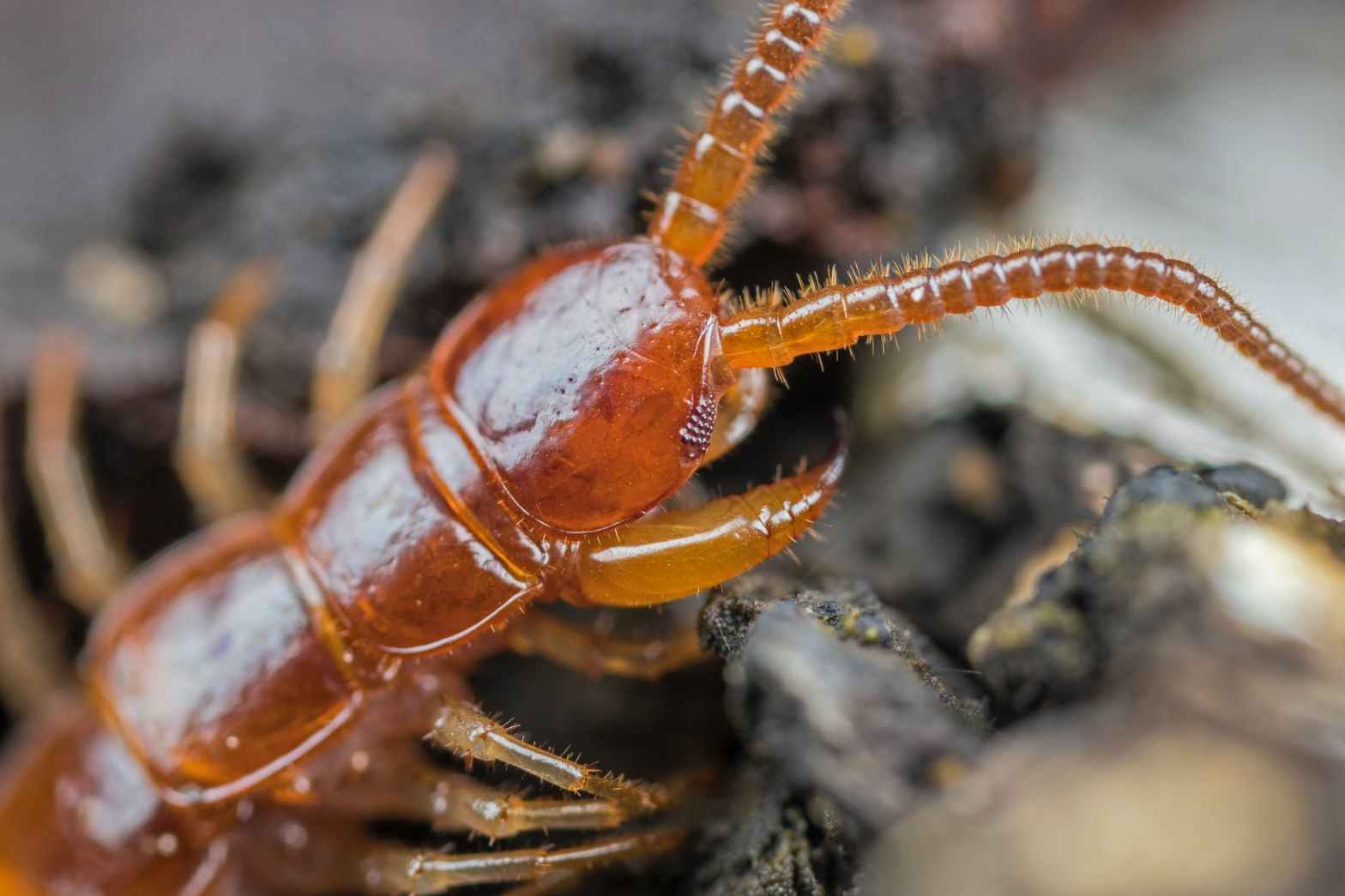
One day towards the end of February, when it was still cold enough that we had so far found little besides a few slugs and some sleepy woodlice, we turned over a stone to see a startled red centipede scurrying for cover. It was fast and agile, bending its body this way and that as it burrowed quickly down into the earth to hide. My son was delighted, and so was I. A few days later I had the chance to find out more, with a fascinating presentation from zoologist Paul Richards.
‘There’s a lot of counting involved’
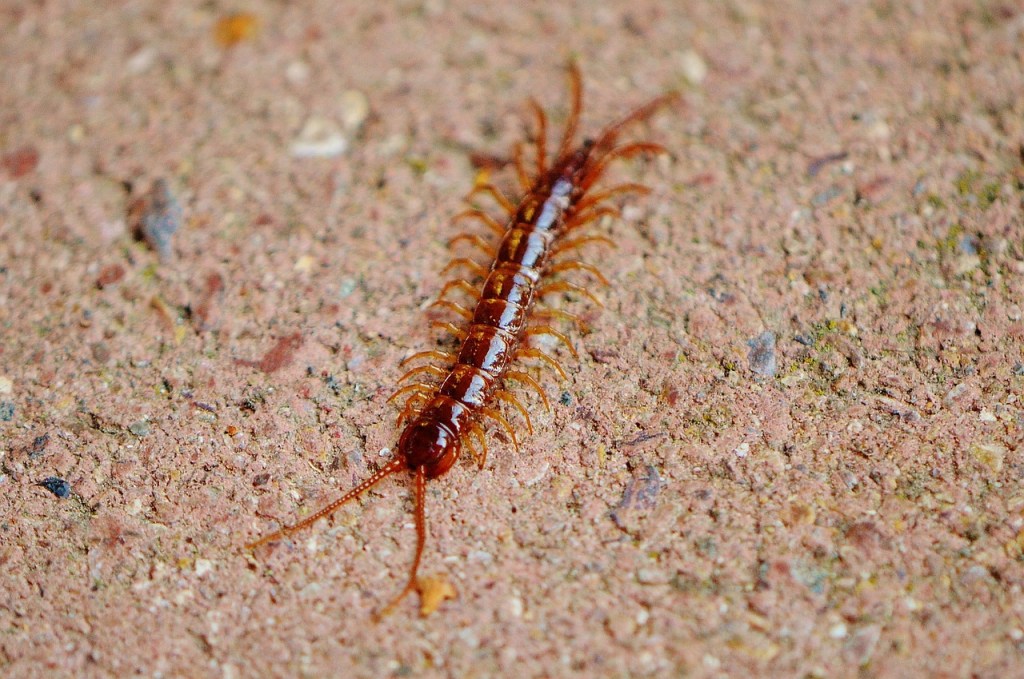
Let’s start where Paul did, with the centipede’s most famous feature. How many legs does a centipede have? Almost any number other than 100, it turns out. A centipede always has an odd number of pairs of legs, so they might have 98 legs (49 pairs) or 102 legs (51 pairs), but never 100 legs.
With 57 different species of centipede in the UK, many of them very similar, there is some fiddly identification involved to work out which one you’re looking at. This involves a lot of counting – and it’s not just about legs. There’s a huge variety between species in the number of body segments (tergites), antenna segments, and even where to find tiny spines and pores in a specific pair of legs.
It’s my first introduction into this world of centipede enthusiasts, and I notice my fellow attendees busily noting down Paul’s tips on identification, a process which is sounding more and more complicated by the minute. And there’s a catch: because some centipedes go through several stages of development, growing a new exoskeleton each time and shedding the old one, they can add on a few pairs of legs as they get older. So, beware when you’re leg-counting: your younger centipede may not even have the right number of legs yet.
A grisly question that’s been on my mind is swiftly addressed as Paul talks about the need to use chemicals back in the lab to identify some of the fiddlier characteristics. He acknowledges that not everyone will want to take a ‘voucher specimen’ – this is a centipede removed from the wild and killed by preserving in alcohol. I feel uneasy about this, and wouldn’t want to kill a centipede in order to study its body more closely. I’d like to find out more about these issues, and hope to return to the ethics of collecting and studying invertebrates in a later post.
Also, to be honest, I feel this minute level of interrogation is not for me. I love watching them, finding out how they move, where they live, what they eat, and some broad differences between groups. But when it comes to knowing which precise species, I just don’t think I have the dedication or patience (not yet, anyway) to pore over – well, pores.
Predator
The way a centipede moves is unique and I think arachnophobes must wince at them too – all those many, many, very fast legs. In fact Paul describes one group (Scutigeromorpha) as ‘the spider of nightmares’. When I see the photo of this very, very long-legged variety of centipede I have a clear childhood memory of spending a long time gazing at one of these inside an old house where I stayed in Italy on holiday. I had never seen anything like it before and remember thinking I should keep an eye on it. Surely, I thought, it must be dangerous. I mean, look at it.
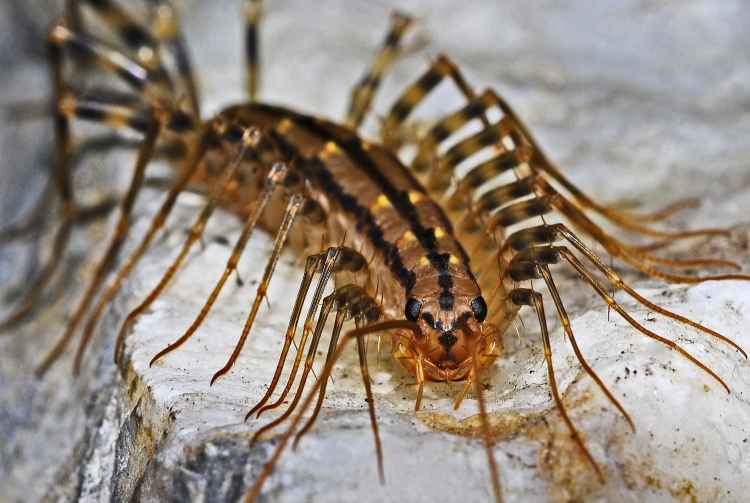
But although they are carnivorous like all centipedes, Scutigera (or the ‘house centipede’) poses no threat to humans. And aerial photos reveal their exquisite beauty, with their legs fanning out as they increase in length further down the toffee-striped body.
Centipedes are predators, built for power and speed. Like their cousins the millipedes, their bodies are divided into segments (tergites), but whereas millipedes have two legs per segment, centipedes have one, making them much faster and able to twist and bend back on themselves. Millipedes feast on dead leaves, so can take life at a more leisurely pace.
And here’s where all those legs come in handy (or footy, if you like) again. Presented with several live prey, says Paul, a centipede can pounce and demobilise one with her strong venomous claws, pass the meal down to the lower legs, and repeat this again and again, all within a matter of seconds. This leaves her time to happily chow down on the unfortunate creature in hand, while keeping hold of her next course, and dessert, in her lower limbs.
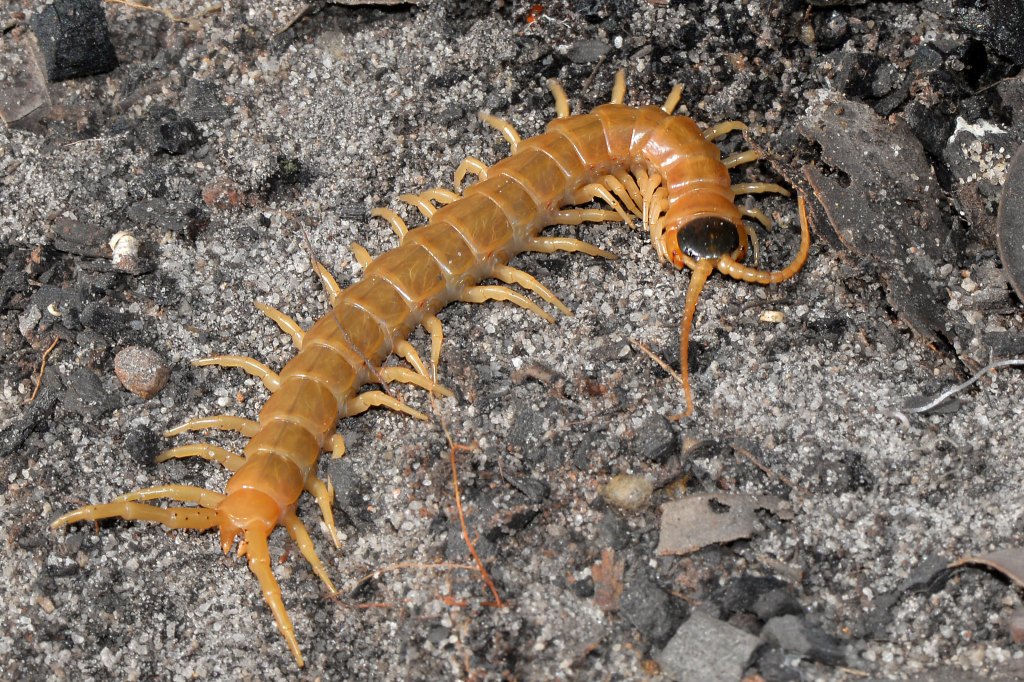
As Paul talks with a shuddering appreciation about the speed with which a Scolopendra will catch its prey, I am reminded of watching incredible footage of giant centipedes who hang from the ceilings of caves in South America and catch bats. Scolopendra gigantea can grow over 30cm long and also devour snakes, frogs and small birds. Here’s that unforgettable clip from the brilliant BBC series Life in the Undergrowth.
I’m also remembering a time when I lived in Thailand, many years ago, and was frequently warned about huge red-headed centipedes who could inflict a painful and dangerous bite. I jumped out of my skin when I eventually saw one in real life, scuttling out of my shower drain and taking a stroll across my bathroom floor.
| Order | Characteristics |
|---|---|
| Scutigeromorpha | 15 pairs of very long legs Also known as the ‘house centipede’ Very fast moving Not common in UK |
| Lithobiomorpha | 15 pairs of legs Common in UK Also known as ‘stone centipedes’ |
| Scolopendromorpha | 21 pairs of legs Mostly tropical centipedes, including giant poisonous centipedes One family represented in the UK (Cryptops: 3 species in UK, all small) |
| Geophilomorpha | 35 – 101 pairs of legs (in UK species) Soil dwelling (also known as ‘soil centipedes’) Very flexible |
Centipede safari
But the centipedes you’ll meet in your back garden or park are smaller and friendlier, and fascinating to watch, so I recommend turning over some stones or plant pots to see who you find.
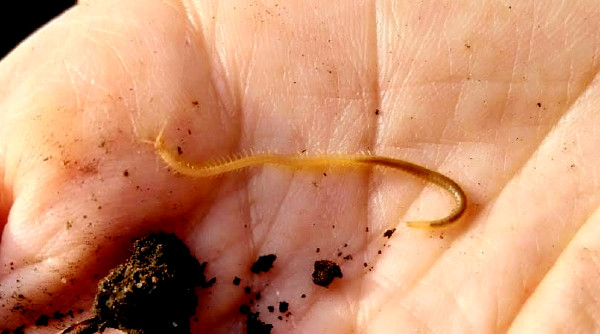
The two broad groups you are most likely to spot are Lithobiomorpha, with fifteen pairs of legs, and Geophilomorpha, who have between 35-101 pairs of legs and live deeper in the soil. Reach for your typical woodlouse hangout: damp leaf litter and bark. Woodlice are a favourite dish for centipedes after all.
A couple of top tips from Paul if you do want to catch live specimens: they may forfeit some legs in order to escape – and if that’s all you’re left with, the abandoned limbs might still help you identify your escapee. Secondly, centipedes might eat each other, so keep them separate!
This centipede life
Among the surprising habits of a centipede is their attention to personal hygiene. We watch a short clip of a centipede having a wash, preening those long antennae with their front legs. It reminds me of the movements of a rabbit as they lick their front paws to clean their long ears.
Many centipedes are also endearingly maternal. They will lay a brood of eggs and stay curled around them, protective and caring (I love this wonderful photograph of a centipede with her babies). I think again of the practice of poaching a centipede from her home and dropping her in alcohol, and wonder about unhatched eggs or babies left unprotected.
I had to leave Paul’s talk as we approached the two hour mark, for a two-year old’s online birthday party. I feel we have only scratched the surface. This was an edited version of a day-long course which itself is merely an ‘introduction’ to myriapods. I am, a typical beginner, amazed by how much there is to know.
I’ve spotted a few more centipedes now that I’ve been looking for them, and having now looked at hundreds of images of centipedes online I am a little bit obsessed. I am wondering where to go next on this journey, and whether any other creature can now measure up to the awesome centipede.
Find out more:
- British Myriapod and Isopod Group: www.bmig.org.uk
- Watch Paul Richards’ talk on YouTube (on the Tanyptera Project channel):
 small world
Loved your blog, Nicola! Very interesting and informative.
LikeLike