
I love spiders, and I want to get to know them better. But they often move fast, and it can be tricky to uncover their hiding places, let alone get a close look at them. So, how do you examine and identify fast-moving arachnids who don’t want to be found? And where are the best places, and techniques, to find them?
On a drizzly Saturday over Easter weekend, around 30 people gathered at Arnos Vale Cemetery in Bristol for a workshop, co-organised by the Bristol Spider Group, to learn about Bristol’s spiders and how we can spot them. Before we set off on our spider hunt, we heard from local arachnologist Michael Davis. He told us that there are around 680 species of spider in the UK, and that you can find spiders in every kind of habitat. He then showed us an array of simple tools we could use to collect them.
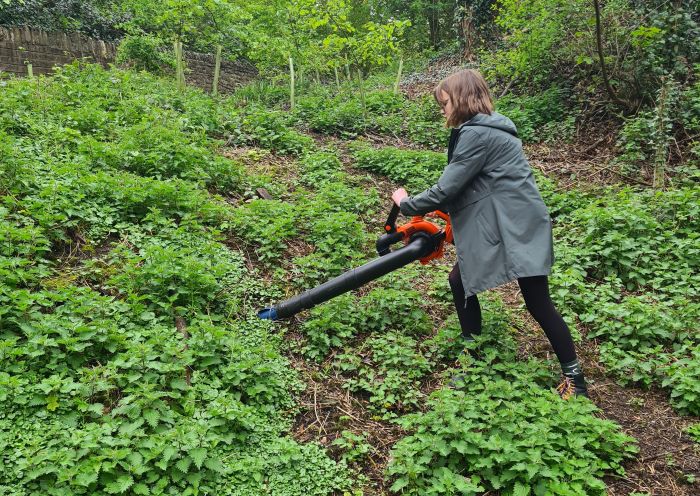
Equipped with pooters, nets, trays, bug pots and a formidable modified leaf-blower, we set out across this beautiful, nature-rich site to see who we could find. I was drawn to one of the many ivy-covered trees surrounding the cemetery. Simply swishing my hand a few times through a small patch of ivy, as Michael had demonstrated, released half a dozen different spiders into my tray. As I encouraged them each into a separate bug pot so I could take a closer look, I could see that each one looked very different. They ranged from a small, spindly, yellow spider to the largest, a beautiful greyish velvety spider which I learned from Michael was a species of ground spider (Gnaphosidae) in the genus Drassodes. As the name suggests, these spiders hunt their insect prey on the ground. Although some spider species can be identified with the naked eye, in order to identify the precise species of Drassodes, I learned, you would need a microscope. Another swish through the ivy and we discovered a beautiful little red spider, a type of comb-footed spider called a Parasteatoda.
We were glad to be joined on our spider adventure by other knowledgeable members of the British Arachnological Association (BAS). Francis from BAS demonstrated an excellent method of tempting a laceweb spider out into the open. Vibrating an electric toothbrush against the delicate tripwires of a web, spun around a crack in a wooden shed, brought the large, dark brown inhabitant running out. The laceweb (Amaurobius) attacked the head of the toothbrush for a few seconds, before realising a trick had been played and retreating.
Other finds included a small, fast-moving blackish-brown species of ant mimic spider (Phurolithus festivus).

My six-year old and I were excited to try out the modified leaf blower. It had been converted into a minibeast hoover, with a net attached to the mouth to suck up and collect tiny creatures from the undergrowth. After running the contraption through a patch of nettles and along a woodpile, we emptied the contents into a tray to reveal several spiders, as well as springtails and a large number of confused woodlice. All of our finds were of course carefully released back into their habitats.
My three-year old was more interested in the collection of spiders Michael had brought with him, collected that morning in his own garden and shed. These included a beautiful, large and glossy noble false widow (Steatoda nobilis) and her close relative, a cupboard spider (Steatoda grossa), as well as a very large cellar spider (Pholcus phalangioides). These are often called Daddy Long-legs spiders, although that’s a little confusing as Daddy Long-legs is also a nickname sometimes given to harvestmen (a different type of arachnid) and also crane flies.
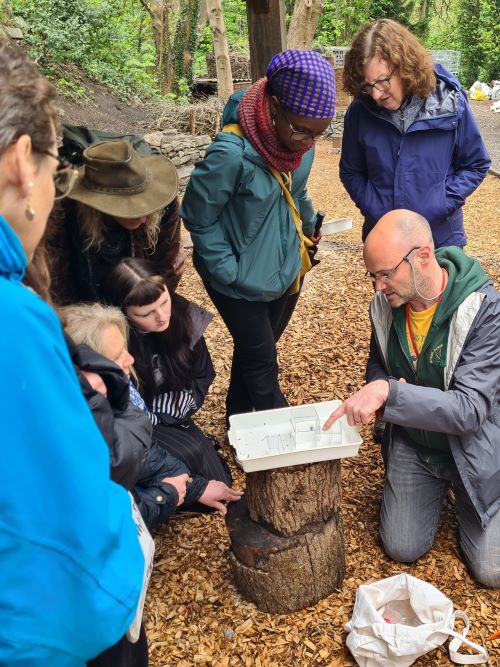
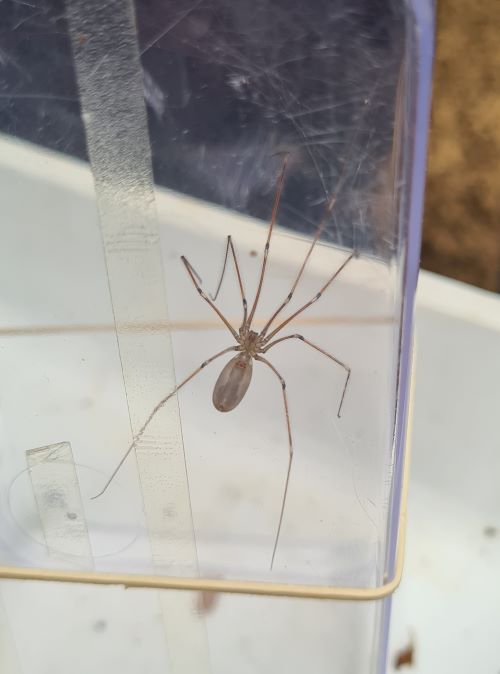

After releasing all of our new spider friends from their pots back into the undergrowth (except for the Drassodes, who scurried straight out of the pot towards the nearest shade which happened to be up my sleeve) we all agreed we were surprised to have found so many different species on this damp day.
It’s great to know that these very simple methods of collecting spiders can be so effective, and that with a bit of knowledge, many spiders can be identified simply by looking at them in the field. I can recommend the book Britain’s Spiders: A field guide, for detail, and the Field Studies Council’s foldout guide to house and garden spiders, for a quick guide to some the most common species.
Find out more:
- The British Arachnological Society is a charity dedicated to advancing understanding and appreciation of spiders and other arachnids.
- The Bristol Spider Group is a group of amateur spider enthusiasts. Drop us a message if you’d like to join and find out about future events like this one.
- Arnos Vale is a 45-acre nature-rich cemetary site in Bristol which organises a range of events.
 small world