I’m standing among a pile of cut willow branches which is currently taking up most of the grassed area in my garden. I am gradually chopping them up into pieces for the compost bin or garden waste collection, but it’s taking a long time. There is so much life on these branches. So many little creatures nestle, crawl or scuttle along the leaves and twigs, and I want to pay attention to all of them.
Relocation, relocation, relocation
The willow tree in my garden grows at an incredible rate. As I’ve written about before, the original tree is a squat dwarf willow with branches that form a dome shape, but new trunks have emerged from near the base and have grown straight, upright, tall – and fast. The winter before last I took drastic measures and sawed each secondary truck off, as close to the ground as I could.
By the end of May this year, new upright branches had already grown several metres high. It needed a drastic pruning, again. I know I should have cut it back earlier in the year, as so many creatures were already making their homes among those supple branches and leaves. But late or not, it had to be done. A couple of years ago I left it to grow and it became excessively tall by mid-summer, casting a long shadow over the neighbours’ gardens and waving wildly in any strong wind.
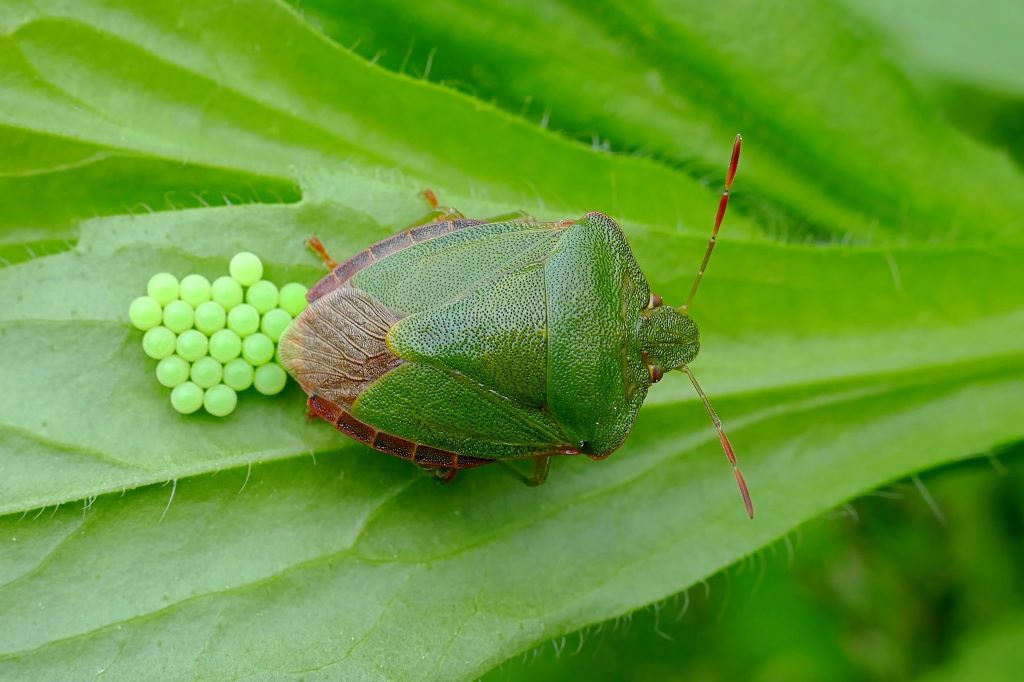
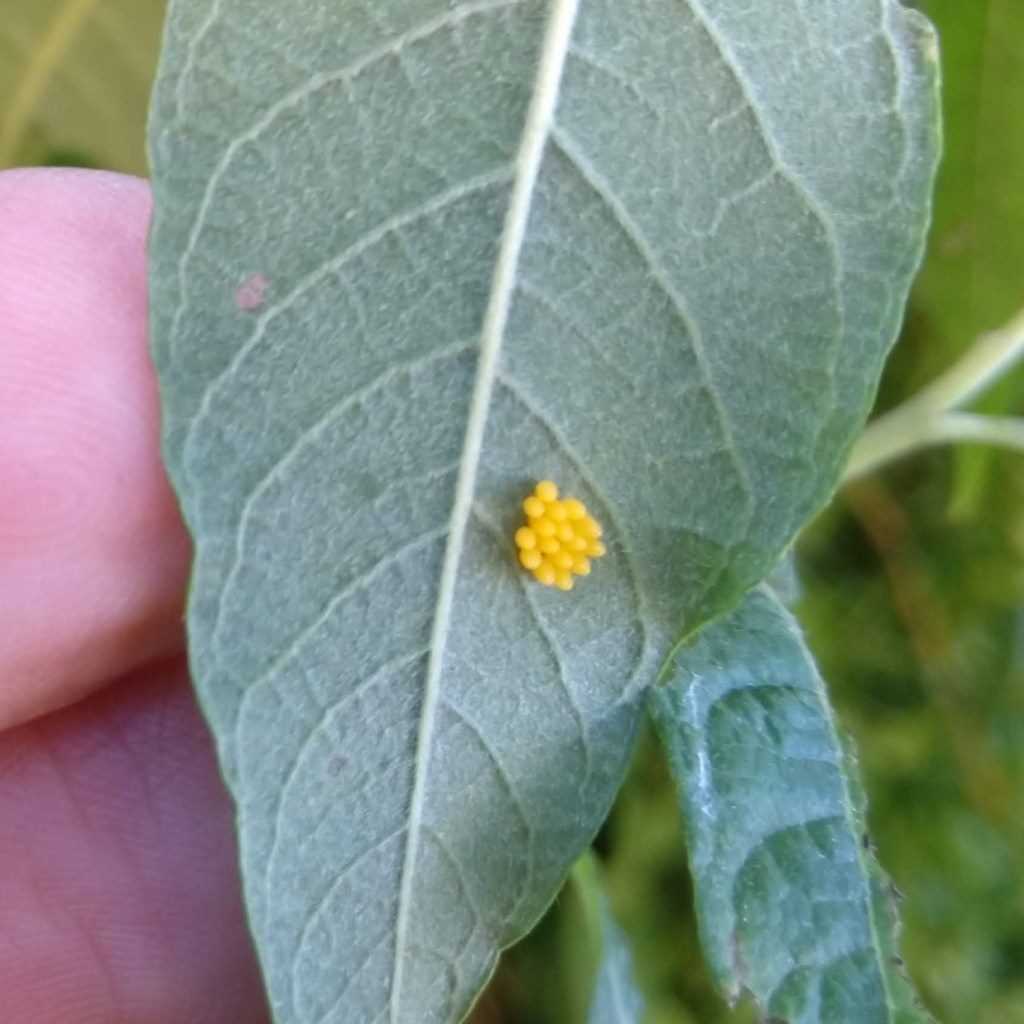
So, armed with a new pair of loppers, a couple of weeks ago I cut back those tall branches. As I lopped and pulled the branches out, I began to notice clusters of eggs on the underside of the leaves. There were ladybird eggs, a deep glistening yellow-orange, shaped like grains of rice. There were other eggs too: round, green eggs perfectly tessellated in hexagonal formations. These were eggs of green shield bugs (Palomena prasina). It was sad to spot these on an already cut branch. I relocated any leaves with eggs on back to the tree, hoping they might still have a chance to hatch out.
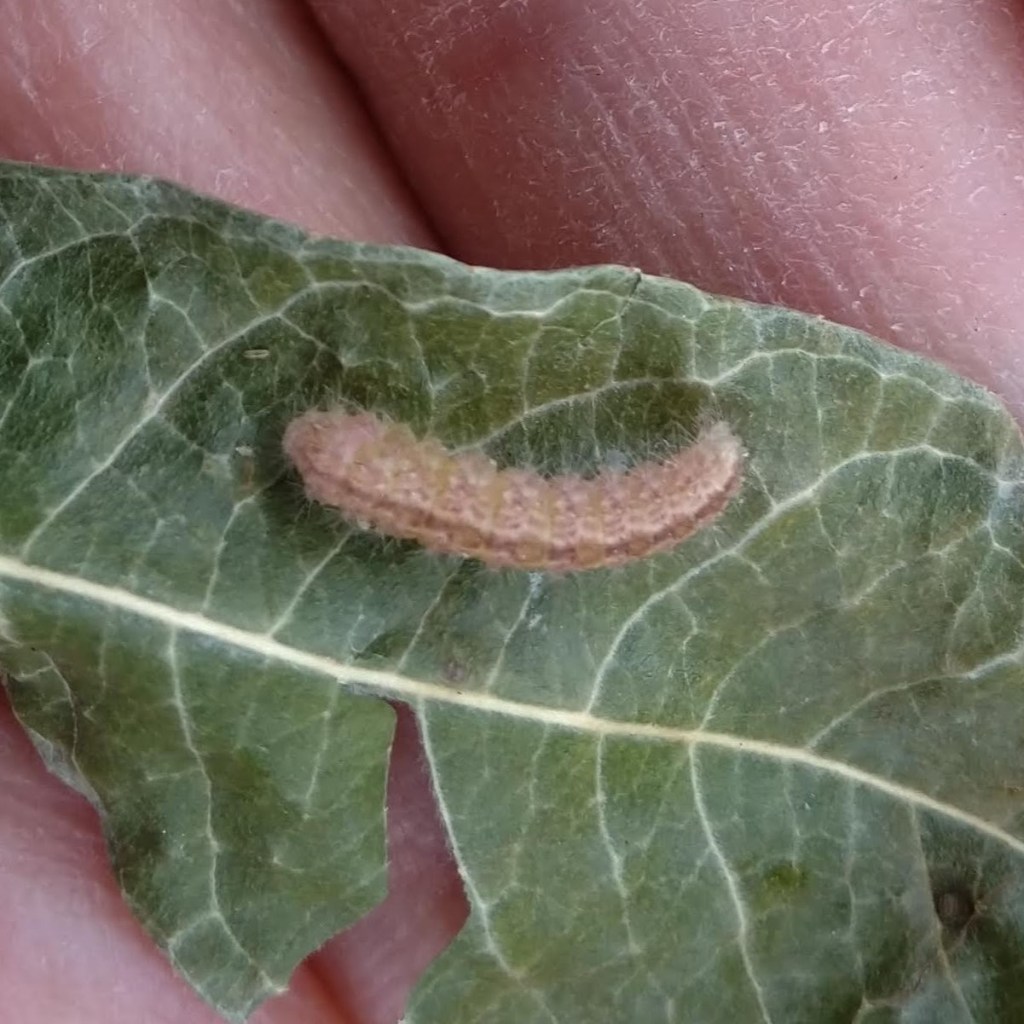
There were caterpillars and snails too, clinging to leaves, who I placed carefully back onto the living tree. Sadly, the mysterious giant aphids don’t seem to have returned since the thick tree trucks were cut.
The remarkable life of a ladybird
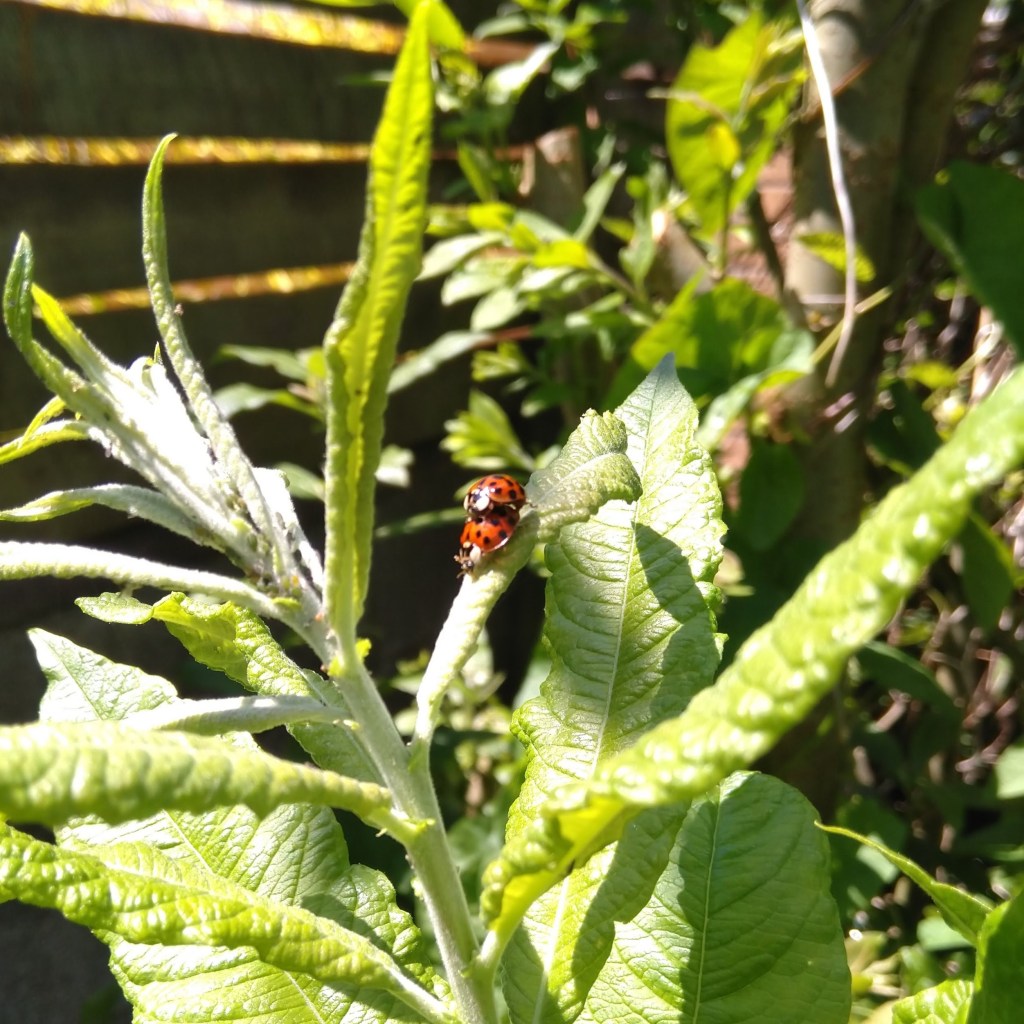
There were many adult ladybirds however, including some mating couples who I did my best not to disturb. At least there were ladybirds still yet to lay their eggs, I thought, giving the tree a chance to support a new generation of these charismatic insects even after my day of destruction. I was happy to spot a pair of mating shield bugs too.
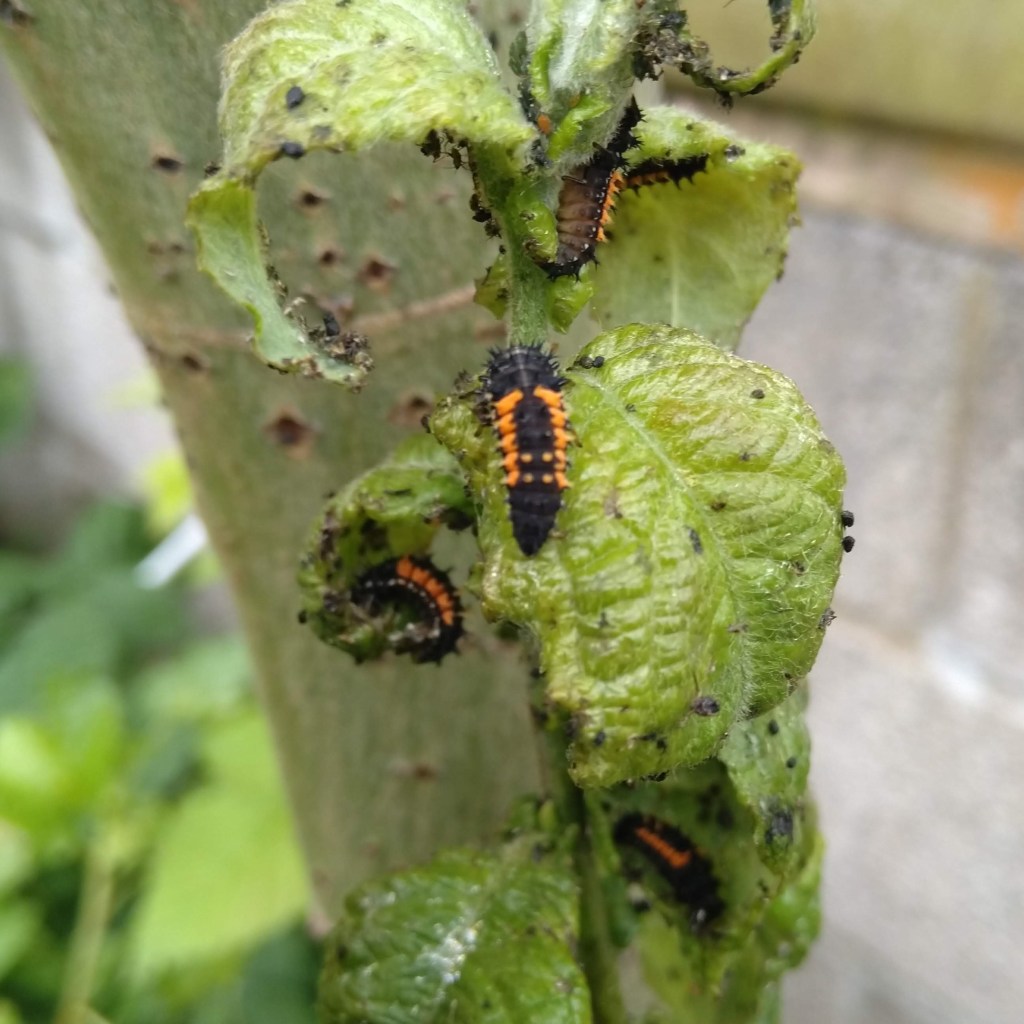
Two weeks later I am still working my way through the pile of cut branches, inspecting each one. I am thrilled to spot ladybird larvae of varying sizes, some of them tiny, which makes me think that some ladybird eggs I missed when cutting the branches have been hatching out still. I gather the larvae up carefully and place them on the living tree.
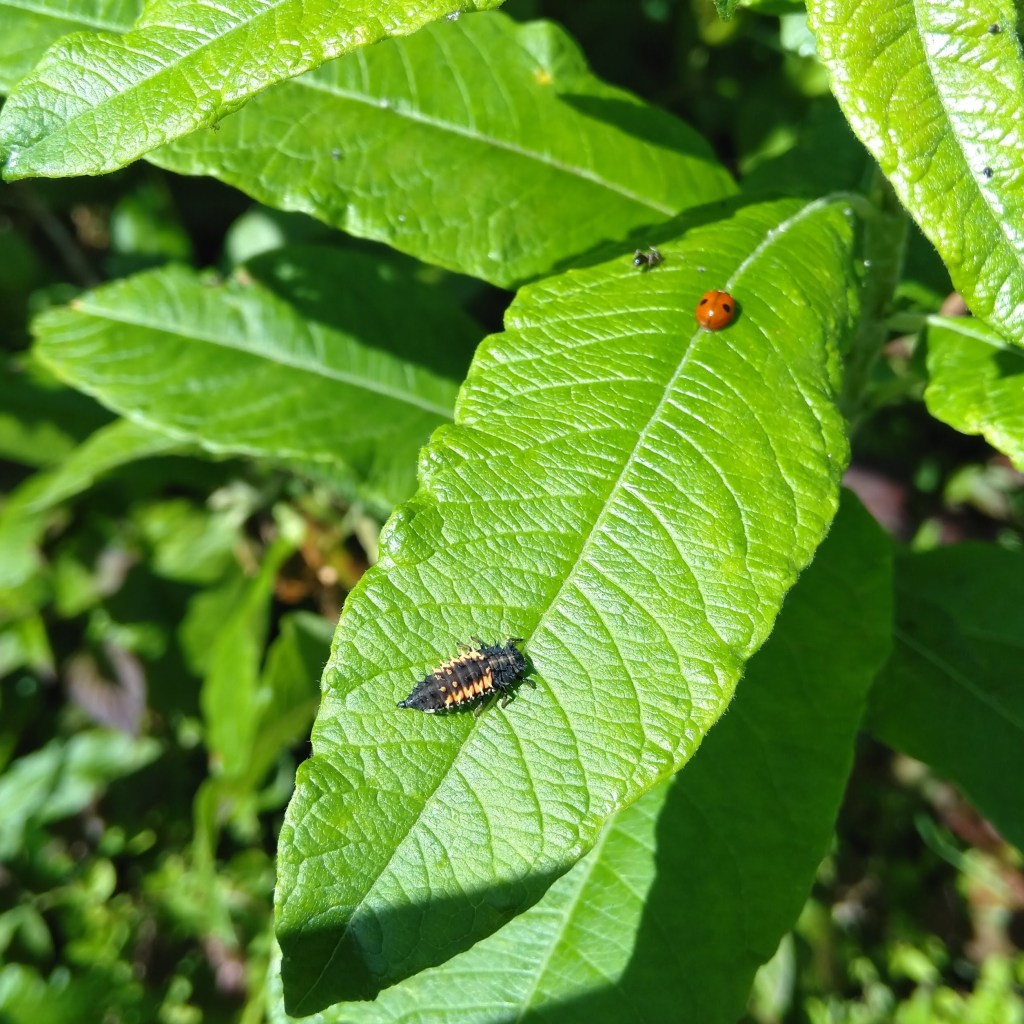
The larvae I’ve seen are, I think, mostly Harlequin ladybird larvae (Harmonia axyridis) although I’ve also seen the smaller ‘2 spot’ ladybird in adult form. The harlequin ladybird is non-native, they were first recorded in Britain in 2004, and have quickly spread to become one of the most common ladybirds in the country.
Ladybird larvae are wonderful creatures, so completely different from their adult form that you would naturally assume they were another creature entirely. The harlequin larva’s long, black body tapers to a pointed tail and appears spiny. They have orange patches along either side of their back, and four orange spots on their lower back, towards the tail. They move purposefully, like tiny alligators – their mission, like all larvae, being to find food and eat as much of it as they can. I’ve spotted large ladybird larvae elsewhere in the garden, devouring aphids.
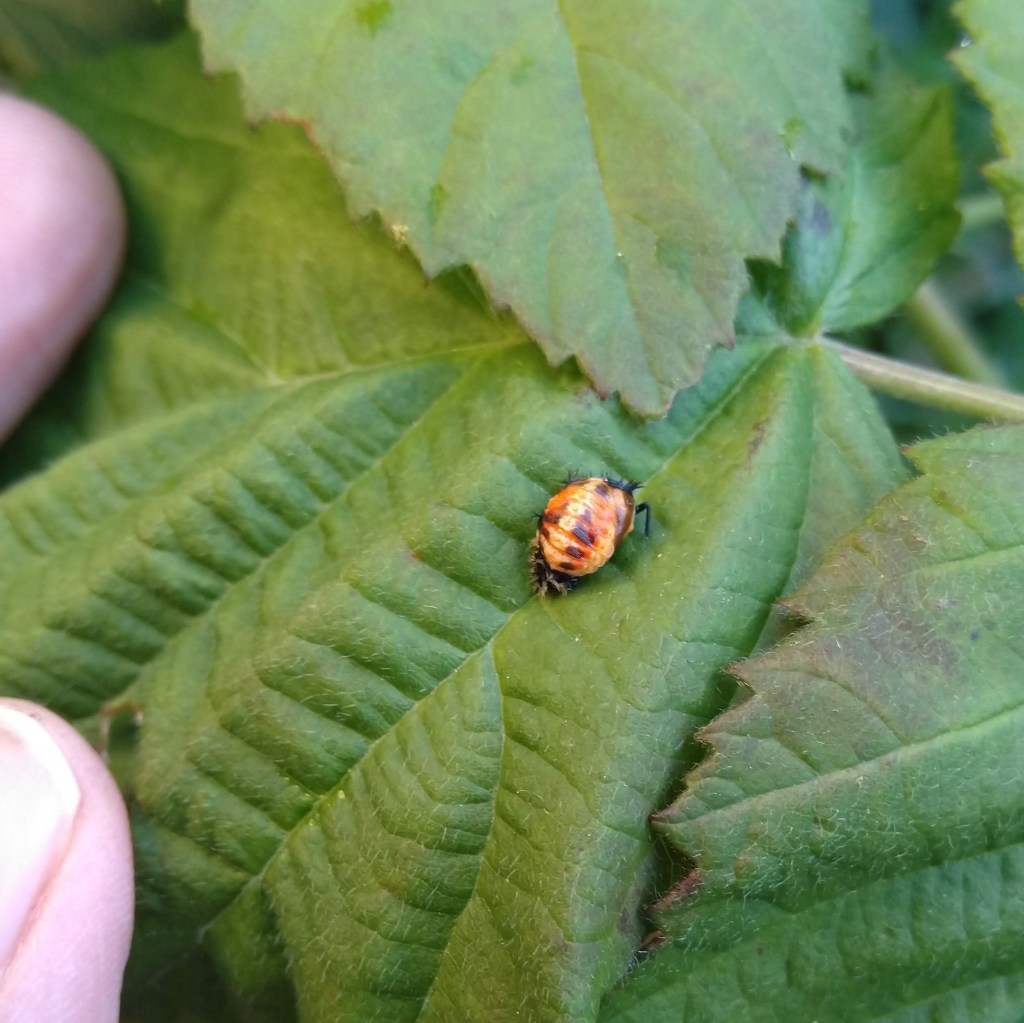
Ladybird larvae emerge from the orange eggs in June or July and go through four stages of growth (called ‘instars’), before becoming a pupa, and then finally emerging as the adult beetle (there’s a nice diagram of the lifecycle here). I was excited to spot a ladybird pupa in my garden this week; I don’t think I’ve seen one before, or known what it was if I have.
Five shades of green
At the recent Festival of Nature in Bristol (the best of all the summer festivals in this festival-blessed city of ours), I took my five-year-old to a talk by entomologist George McGavin, and others. I was fascinated to discover that the green shield bug undergoes several stages of metamorphosis.
Green shield bugs hatch out of their eggs around June as wingless nymphs. They go through five instars, outgrowing their exoskeleton five times before becoming an adult. Although not as dramatic a transformation as a ladybird or butterfly, at each of these stages they do look surprisingly different.
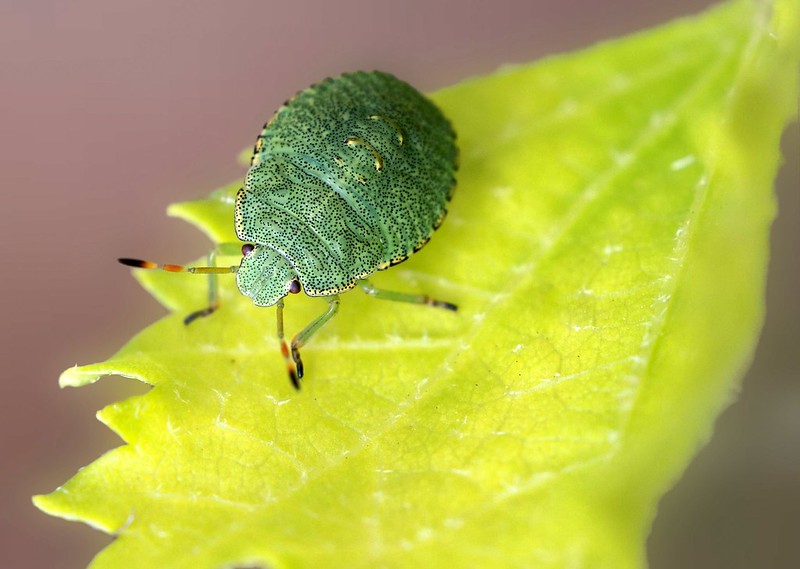
Shield bugs feed on sap but don’t cause any harm, and it’s a real delight to see them. They hibernate over winter in leaf litter or tussocky grass, so you can help them by leaving or creating these habitats for them to take shelter in.
I’m keeping my eyes open for the little nymphs in my garden, but haven’t spotted any yet.
A new habitat
As I sort through the last of the cut willow branches, shaking them to help the creatures drop off, I notice some very tiny beings falling to the ground and scurrying off to find shelter. It seems that the lower layers of my branch pile have become a nursery for spiders and earwigs, as well as a whole host of slugs and snails.
I’ve put piles of willow leaves in the compost bin, I’ve put thinner stems and branches into garden waste bags and I’ve relocated dozens of insects, spiders, snails and eggs back to the living tree. I am left with a pile of slender logs, wondering whether to turn them to woodchip. But given the number and variety of creatures that have made their home in these branches, I’m going to find a good spot in a corner of the garden for a little log pile and let these parts of the tree become a new habitat for beetles, woodlice and whoever else wants to take shelter there.
Like the transformations taking place for the ladybirds, shield bugs and other creatures in its branches, the tree will continue to go through cycles of change and be a home for many, many little lives all year round. But when it comes to next year an early, heavy pruning is definitely top of my list.
Find out more
- The RHS has more information about Green shield bugs, and how to spot the difference between the common green shield bug and the non-native southern green shield bug.
- Visit the UK Ladybird Survey for lots of information about different species of ladybird, how to identify and record them.
- Learn more about caterpillars, moths and butterflies from the Butterfly Conservation Trust, and take part in the Big Butterfly Count this July/August.
Main image: Green shield bug laying eggs, by Matej Schwarz
 small world
One thought on “Shield bugs, ladybugs, and baby bugs too”