
“How do you choose which ones to relocate?” asks my husband as I hand him the tupperware container. Inside there are twelve caterpillars of varying sizes, most of them gathered on a small green leaf with ragged edges. A couple are curled up, still playing dead. I shrug. “I pick up the wanderers. The ones who are searching.”

I’ve come up against the harsh reality of nature, playing out here in my small garden in Bristol. In this space which I care for, where the little creatures have a home, every year stunning black-and-red cinnabar moths (Tyria jacobaeae) come to mate and lay their eggs on the underside of ragwort leaves. Their babies hatch and feed on the plants until they grow fat and crawl off to build their underground metamorphosis chambers, the secret site of the most miraculous of nature’s magic transformations.
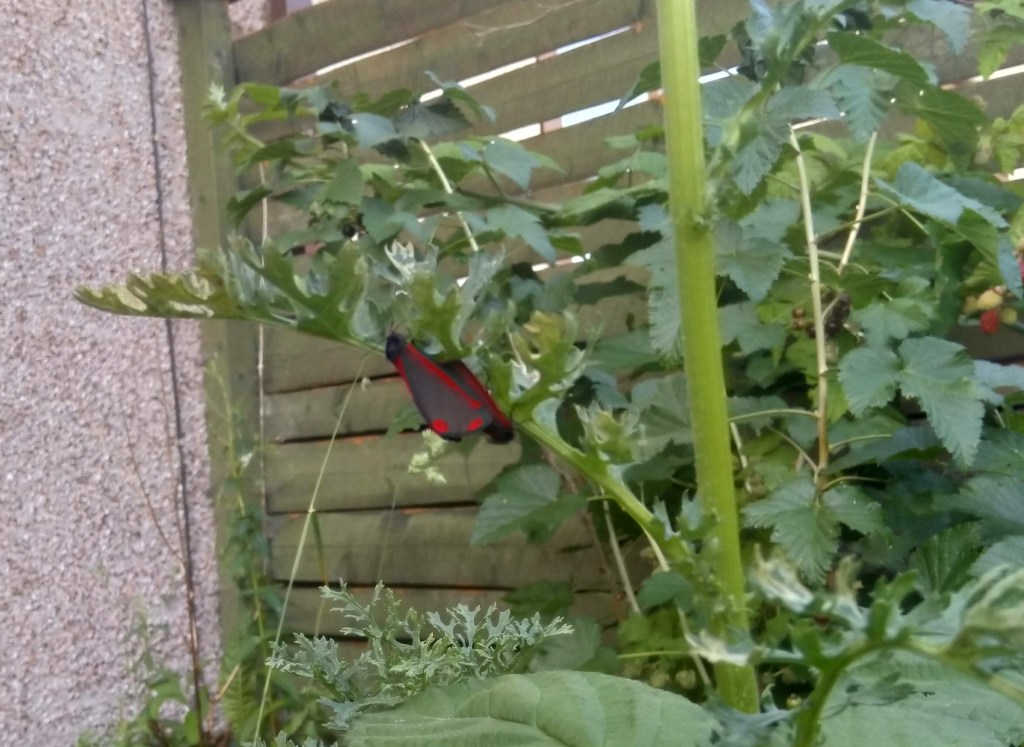
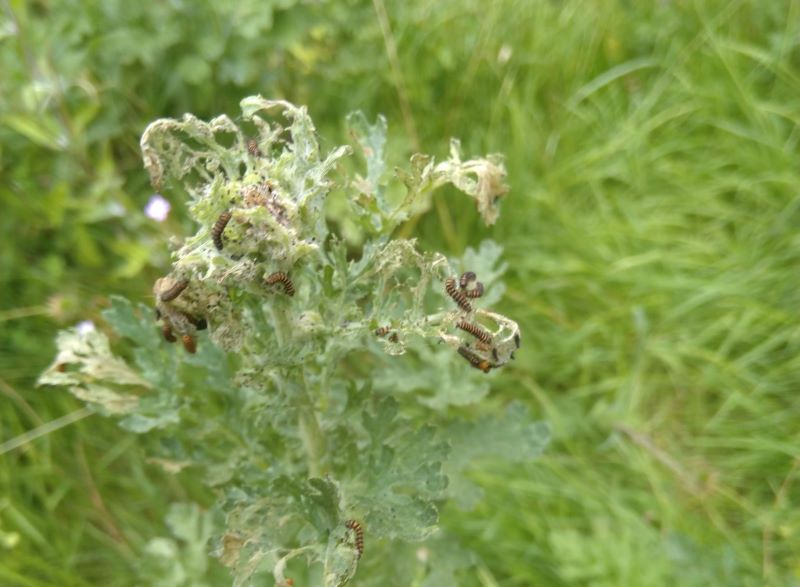
It started well this year. By mid-June the ragwort was thriving and the newborn caterpillars had begun to appear. Soon they were outgrowing their baby skins, leaving their old exoskeletons behind as they moulted, grew bigger and chomped their way through their favourite food.
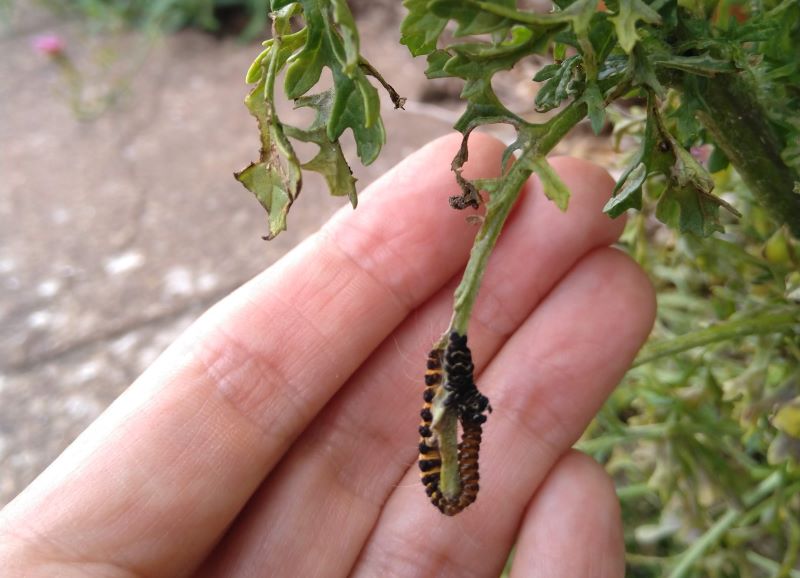
It was hot and dry in June. I had been watering the ragwort carefully, at the base of the plant to avoid disturbing any caterpillars, eggs or moths, although sometimes as I worked my way around the plants a flutter of black and red wings rose up and danced away through the air. When the caterpillars sensed the water they started waving, dozens of orange-and-black beings jerking their heads about in a spontaneous dance to the rain.

But within a couple of weeks, hundreds of caterpillars crowded the ragwort plants scattered around the garden. It quickly became clear that there was not nearly enough of this, their only food, to support their numbers. They had overpopulated. Dozens huddled on each bare, useless stem they had decimated by devouring every leaf and flower.
In past years I have found the occasional caterpillar wriggling across the concrete, searching for more food. I’ve helped them on their way, relocating them to a leafy plant. Two years ago I was worried that the ragwort seemed in short supply, only to find it thriving again the following year. This year the ragwort seemed abundant enough, but it could not feed so many caterpillars.
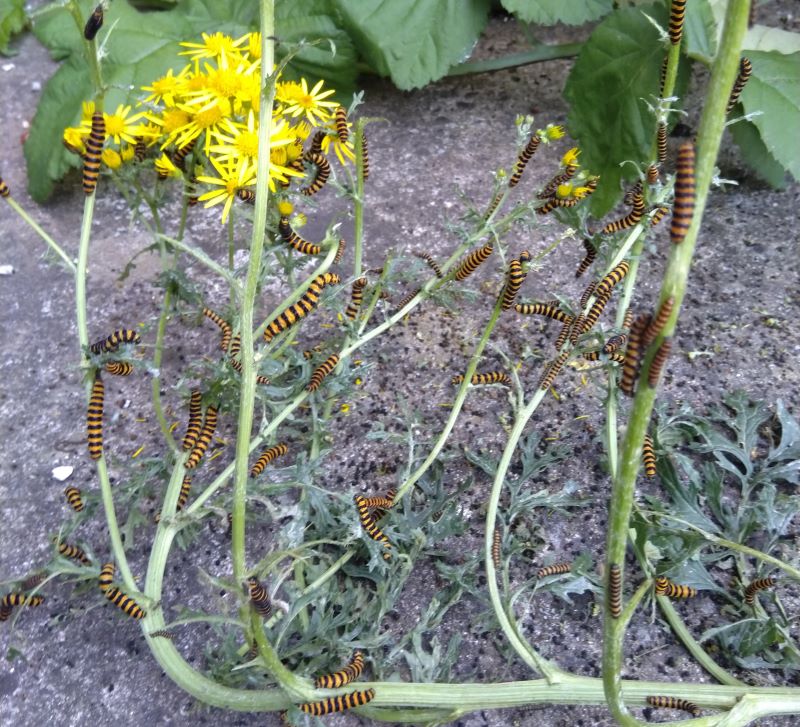
Each time I went into the garden I came across several wanderers. Some of them were tiny, only just hatched and surely too young to be leaving their birth plant. I gathered these lost ones, and when I picked them up they instantly curled up in defence. I placed them gently on one of the less busy plants (which is tricky to do when they are playing dead, as they tend to let themselves drop lifeless to the ground rather than clinging on). All the plants quickly became crowded though, and I couldn’t help them anymore. They won’t eat anything else. They reached out from the naked stems with their head and front legs, waving around in the air as though trying to catch a scent of the way to go.
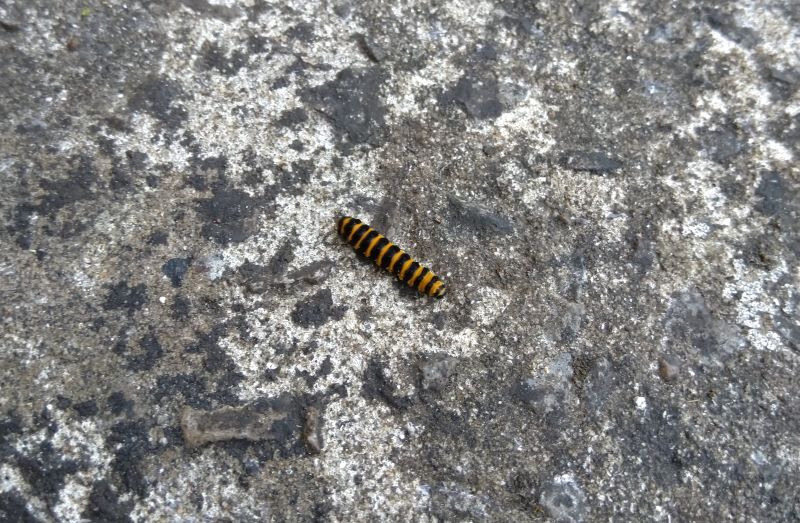
I found caterpillars crawling up the watering can, along the drainpipe, optimistically scaling a tall blade of grass or floating in the water at the bottom of a bucket, their journey over. Some of the bigger, stronger ones ventured up to the top of thick, metre-high ragwort stems but found nothing to eat there, and made their way back down again.
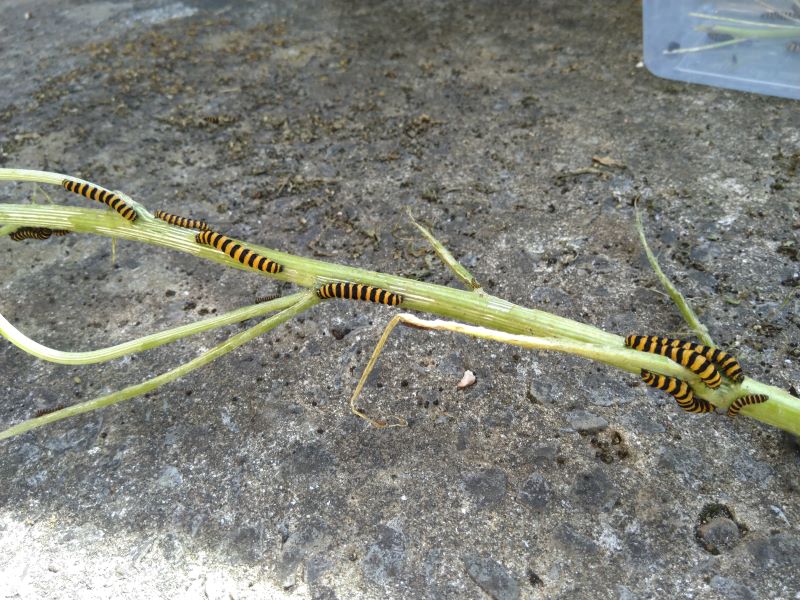
I grew sad and tired of this. When I closed my eyes I saw them, hundreds of striped caterpillars behind my eyelids. They wouldn’t survive, most of them. They would crawl up and down the bare stalks, or cling to their nutritionless spot until they lost the fight, dried up and starved. Or they would wander across the garden and beyond in vain until they tired and perished. They couldn’t see what I could: that the ragwort forest was gone, the few remaining leaves already occupied by their sisters, brothers, cousins, competing for the last mouthfuls. Some of the biggest will make it, I suppose. And somehow next year, I hope, there will be fewer. Boom and bust.
I find the caterpillars when I am out and about too, wriggling up a fence or down a garden wall. Where are they going? In this urban world where if they venture in the wrong direction, if they find themselves on the wrong side of a garden wall or hedge, they find a vast and unfriendly terrain of concrete and tarmac which their millions of years of evolution have not equipped them for. Finding them makes me wonder, have they overpopulated everywhere this year? If so, conservationists would say this has been a good year for cinnabar caterpillars. But it doesn’t feel like a good year, and as I transfer another wriggling baby to our one remaining leafy plant – growing from a crack in the concrete of our front garden – I reflect that this is why I was not cut out for a career in conservation. I am hopelessly, desperately sentimental. Helping just a few and leaving the rest to their fate feels like a brutal choice, an arbitrary wielding of a terrible power.
A patch of hope
On a walk last weekend with my four year old son we saw a lush green patch of ragwort in full yellow flower at the side of a park near our home, with just a few caterpillars munching on their leaves. “We could bring the caterpillars from our garden here, then they would have lots of food to eat!” said my son.
So that’s what we did. Late afternoon we gathered fifty or so caterpillars from the bare plants in our garden and brought them over to this land of relative plenty. Hoping we had done the right thing for them, we watched as they uncurled and clung on to the new plants, which they seem to do with their jaws.


We had left some of the larger caterpillars in our garden, wondering if they might have a better chance and be almost ready to pupate. But the following evening most of them were still clinging hopelessly to the bare stems in the garden, so I gathered up another fifty or so, and in the pouring rain this time I returned to the park. I was disappointed to spot only a dozen or so caterpillars on the plants we placed them on the day before, but perhaps they had dispersed and were just difficult to spot. I have no idea if we have done the right thing, but it feels like we have given these caterpillars a fighting chance where before they had little.
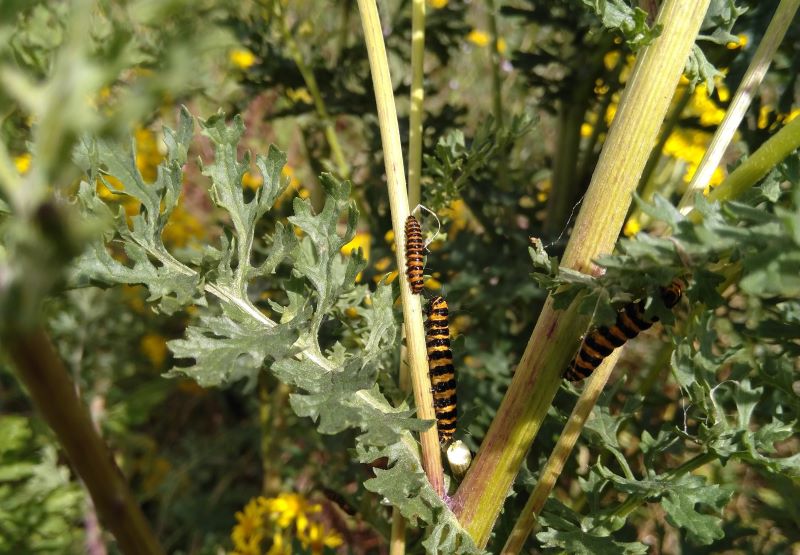
I wonder how it feels to be a caterpillar. I imagine crawling across the dark ground through the towering grassy forest in search of food, feeling the firmness of a stem and then the familiar feel or smell of a ragwort leaf, knowing instinctively that this is the nourishment I need. I imagine the relief or satisfaction that comes, and how that might feel to a hungry moth larva. It’s impossible to know how they feel, of course, and I cannot help projecting my own human experience of the world. It’s all I’ve got. I do know that they have a determination to survive. I have seen them venturing across inhospitable pavements in search of food, I’ve seen them dropping into the grass in defence when under threat, and I know that their bright stripes are a warning to predators against feeding on their toxic flesh.
If nothing else, relocating them has given me a sense of purpose and relief to have done something rather than watching them all starve and die in the garden, feeling powerless.
On a trip to Swansea last week I did a little dance inside when I saw ragwort thriving around the university campus, with dozens of cinnabar caterpillars clinging to the plants despite the stormy sea winds. It seemed that although there may be rough times ahead, the will to survive is strong. Their determination will ensure that at least some of them make it, if they still have a chance and a home.
 small world
One thought on “A determination of caterpillars”