At the back corner of our small urban garden is a stumpy umbrella-shaped tree which, I think, is a type of dwarf willow. It was there when we moved into our house five years ago, and since then the trunk has tilted further each year so it is now leaning at a forty-five degree angle against the wall at the back of the garden. The tree’s branches form a dome of leaves which cascade to the ground, creating a dark den underneath where the neighbourhood cats come for shade and to stalk the family of mice who live there.
From the base of the tree have grown four new trunks, a set of sisters sprung from the mother tree. These trunks grow straight, strong and tall. Their branches don’t cascade in a dome shape, but reach up into the sky. In the summer these branches grow very fast, and most years I have taken snippers or loppers to them, cutting them right back. Two years ago I sawed off one of the trunks completely. But last winter I didn’t do anything, being heavily pregnant and heavily distracted – and this summer the upright branches grew and grew, as tall as the houses, and their combined thick leafy crown cast an imposing shade over the surrounding gardens.
Thorny questions
In May I noticed some fantastic little creatures gathering in huddles on the bark of these sister trees. The insects’ kite-shaped bodies were grey with black spots, and each one had a black horn protruding from their back. They had long black legs and looked very unfamiliar.

I discovered, using the excellent iNaturalist app, that these were Giant Willow Aphids (Tuberolachnus salignus), thought to be the largest aphid species with a body length of up to 5.8mm.
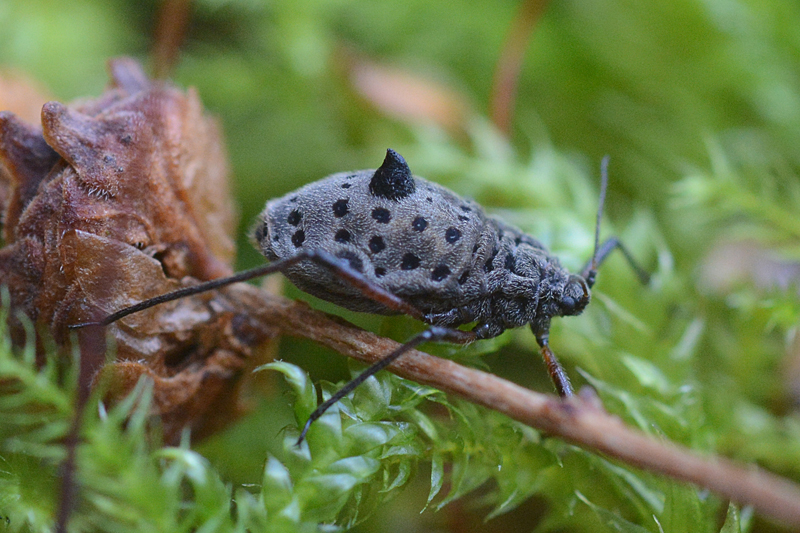
Why do they have a horn on their back? No one knows, according to the late entomologist Professor Simon Leather:
A great unsolved mystery about this aphid is the function of the dorsal tubercle, which so closely resembles a rose thorn, or to me, a shark’s fin.
Professor Simon Leather
Let’s stick together
In July our tree began buzzing. The willow’s leaves and branches were crowded with bumblebees, honeybees and wasps, and a fine glittering rain seemed to be falling from the branches. Then the grass and plants under the tree started to turn black. What was going on?

It turns out that our jumbo sap-sucking aphids were producing a sugary liquid called honeydew, which wasps love for its high energy content. The wasps and bees were stumbling all over the place to get at this shiny sticky stuff which was coating the leaves.
The honeydew was also responsible for turning the grass and plants black, but thankfully it doesn’t cause any harm.
The RHS says these mammoth aphids are also not a major problem for the tree (although some other sources disagree):
These aphids are part of the biodiversity healthy willow trees can support and are the basis for many food chains. Even high densities of aphids seem to have no significant effect on the tree’s health or vigour.
Royal Horticultural Society
So if you find these aphids in your garden, says the RHS, there’s no need to control them. If you really want to get rid of them, you could encourage more aphid predators into your garden who will be glad of the feast, like ladybirds.
Let the sunshine in
I’ve been advised by a trusted gardener friend that if we want to save the original mother tree, we will need to remove the secondary trunks. My friend adds that people tend to try and control willow tree growth in gardens as the roots can threaten foundations. So this winter I plan, reluctantly, to cut the sister trunks off at their base. In spring and summer this will bring big changes to the garden: less shade, more sunlight, and without the thick leafy branches the sparrows and goldfinches will need to find new hiding places as they wait for their turn on the bird feeder.
As for the Giant Willow Aphids: I’ve enjoyed observing these intriguing insects, but hopefully there will be fewer of them next year and so not quite as many wasps in the garden. Although they didn’t cause us any trouble, it would be nice to safely walk barefoot on the grass again. We won’t find out until late spring though, as another great mystery about these mega minibeasts is that no one has any idea where they go between February and April.
 small world
One thought on “The mysterious mega aphids”